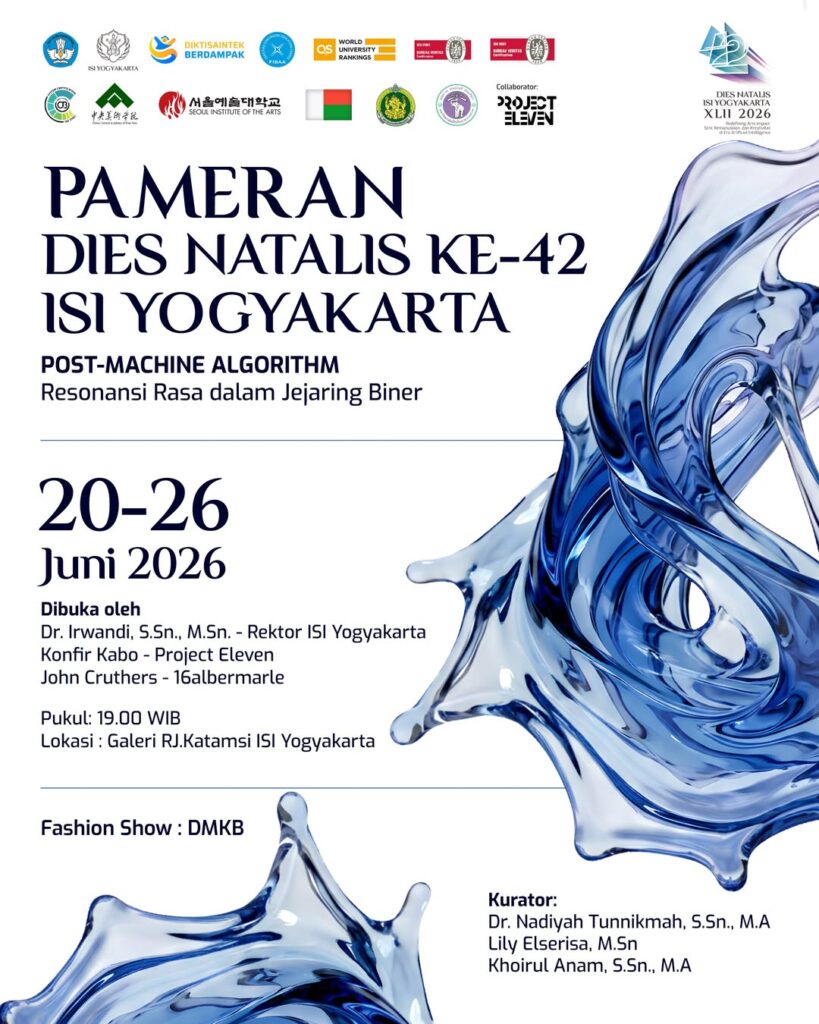


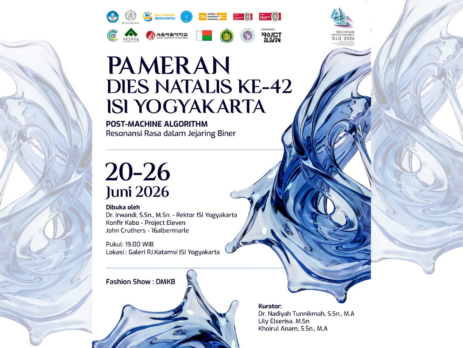
YOGYAKARTA, June 13, 2026 – The Indonesian Institute of the Arts (ISI) Yogyakarta reaffirms its position as a leading arts higher education institution by holding a fine arts exhibition titled “Post-Machine Algorithm: Resonance of Feeling in the Binary Network” at the RJ Katamsi Gallery of ISI Yogyakarta. The exhibition, part of the 42nd Dies Natalis of ISI Yogyakarta, will open on June 20, 2026, at 7:00 PM Western Indonesian Time and will run until June 26, 2026.
Embracing the spirit of the 42nd Anniversary, “Redefining Arts Impact: Art, Humanity, and Creativity in the Era of Artificial Intelligence,” this exhibition presents a space for critical reflection on the relationship between humans, art, and technology amidst the increasingly massive development of artificial intelligence.
Through the exhibited works, artists are invited to explore how artistic practice remains a space that holds intuition, inner experience, emotions, and traces of humanity that cannot be fully replicated by algorithmic systems. This exhibition not only showcases art as a visual product but also positions art as a medium for dialogue that questions, responds to, and negotiates the changes of the times.
The Post-Machine Algorithm theme was born from the realization that the development of digital technology and artificial intelligence has changed the way humans work, communicate, and create. In this context, art emerges as a space to re-examine the position of humans amidst increasingly complex binary networks.
This exhibition offers the perspective that behind the speed of computation and analytical capabilities of machines lies a dimension of feeling, empathy, intuition, and life experience that forms the primary foundation of artistic practice. The tension between feeling and logic, human and algorithm, becomes the starting point that artists explore to create various forms of reflective and critical visual expression.
The exhibition curators, Dr. Nadiyah Tunnikmah, S.Sn., M.A., Lily Elserisa, M.Sn., and Khoirul Anam, S.Sn., M.A., designed the exhibition as a meeting space for various ideas about the future of art in the post-digital era. Through this curatorial approach, the public is invited to understand that technological development should not always be seen as a threat to creativity, but rather as a new field that opens up opportunities for collaboration, adaptation, and critical reflection.
As a higher education institution for the arts that continuously promotes innovation, ISI Yogyakarta views the issue of artificial intelligence as an important part of the development of the contemporary art ecosystem. Therefore, various agendas for the 42nd Dies Natalis not only present academic and cultural celebrations but also serve as a space for strategic discussions about the future of art, education, and humanity in the digital era.
The organization of this exhibition also demonstrates ISI Yogyakarta's commitment to developing art education practices that are adaptive to technological advancements without losing humanistic values. Amidst global transformation driven by the progress of artificial intelligence, ISI Yogyakarta continues to strengthen its role as a center for the development of art, culture, creative research, and critical thinking relevant to the challenges of the times.
Through the Post-Machine Algorithm: Resonance of Feelings in Binary Networks, ISI Yogyakarta invites academics, artists, students, creative industry practitioners, and the general public to engage in a conversation about the future of human creativity. This exhibition is expected to be a space for appreciation and collective reflection on how art can remain a marker of humanity amidst the dominance of technology and algorithms.
By presenting discourse relevant to global developments, this exhibition further strengthens ISI Yogyakarta's position as an arts higher education institution that not only produces works but also serves as a center for the production of knowledge, ideas, and innovations that contribute to the development of art and culture at both national and international levels.