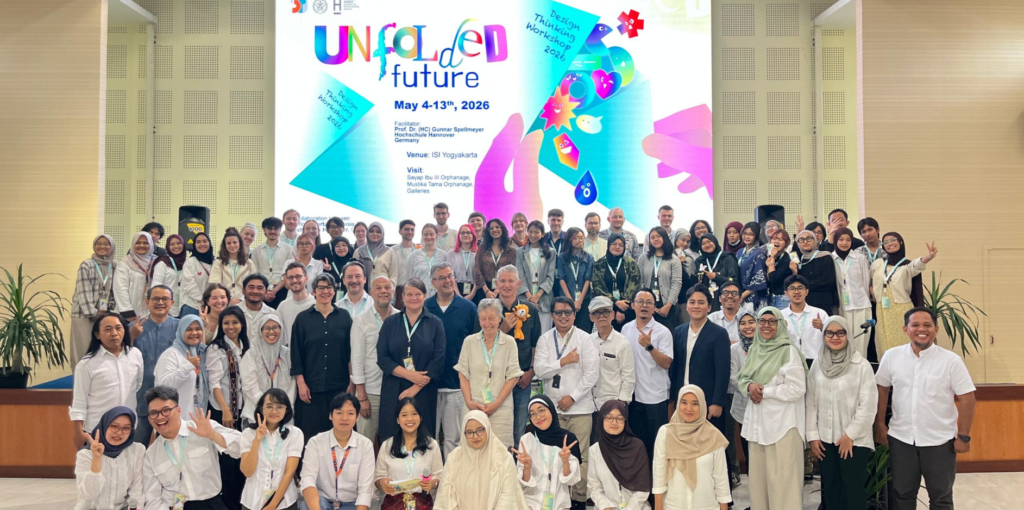


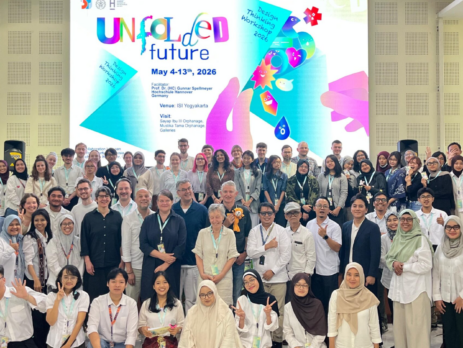
Yogyakarta — The Indonesian Institute of the Arts (ISI) Yogyakarta is strengthening the role of higher arts education in addressing social challenges by holding the Design Thinking Workshop 2026 with the theme “Unfolded Future”. This event is held in collaboration with Hochschule Hannover University of Applied Sciences and Arts, Germany, and was opened at the Ajiyasa Building, Faculty of Fine Arts and Design ISI Yogyakarta, Monday, May 4, 2026.
This workshop is part of the continuation of the international academic cooperation between ISI Yogyakarta and Hochschule Hannover, which has been established since 2014. Through this program, ISI Yogyakarta provides a collaborative learning space that brings together students, academics, practitioners, social organizations, and stakeholders from the orphanage environment.
The Design Thinking Workshop 2026 will take place over eight days, from May 4-8 and May 11-13, 2026. The event will be facilitated by Prof. Dr. (HC) Gunnar Spellmeyer and the academic team from Hochschule Hannover. The involvement of undergraduate and postgraduate participants enriches the learning process through cross-disciplinary dialogue, exchange of perspectives, and real-world problem-based design practice.
The theme “Unfolded Future” was chosen to affirm that the future of children, especially those in orphanage environments, is a continuously evolving space that can be shaped through empathy, creative intervention, and collaborative work. In this context, design is not only understood as an aesthetic practice but also as an approach to understanding social needs and formulating impactful solutions.
Through the design thinking framework, participants are guided through a step-by-step process, starting from empathy, problem definition, idea generation, prototyping, to evaluation. This approach is reinforced through field observations and direct interaction with children in orphanages, ensuring that the design ideas developed stem from lived experiences, contextual needs, and the social realities faced by the community.
Muhamad Sholahuddin emphasized the importance of design as an agent of social responsiveness and sustainability. Meanwhile, Dr. Dewanto Sukistono highlighted interdisciplinary collaboration as a crucial strategy in addressing increasingly complex social issues. These views demonstrate ISI Yogyakarta's commitment to positioning art and design as academic strengths relevant to the needs of the times.
Besides strengthening social aspects, this workshop also presents an industry perspective through a session with Aria Sungsang Nir Prahara. The session discussed the transition from hand-skill-based production to a more scalable manufacturing system, enabling participants to understand design not only as a conceptual idea but also as a practice that can be developed into production strategies and the sustainability of the creative industry.
The organization of the 2026 Design Thinking Workshop is proof that ISI Yogyakarta continues to develop an adaptive, inclusive, and socially impactful art and design education ecosystem. Through international cooperation, interdisciplinary approaches, and direct community engagement, ISI Yogyakarta reinforces its position as an art and design higher education institution that not only produces works but also provides creative solutions for social life.
As a state-owned higher education institution for the arts established on July 23, 1984, ISI Yogyakarta offers art education from diploma (D3, D4), bachelor's (S1), master's (S2), to doctoral (S3) levels, covering a wide and comprehensive range of art disciplines. Through activities such as the Design Thinking Workshop 2026, ISI Yogyakarta continues to strengthen its contributions to education, research, international cooperation, and the development of arts and design that have a positive impact on society.