

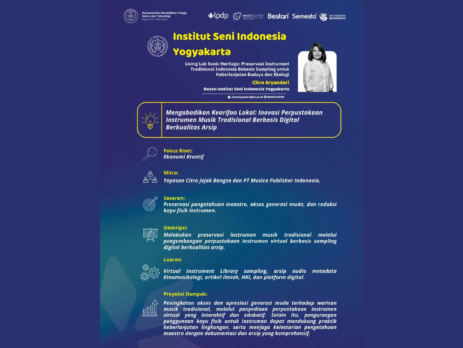
Yogyakarta, May 1, 2026 – The Indonesian Institute of the Arts (ISI) Yogyakarta reasserts its role as an institution of higher learning in the arts that not only focuses on the development of artistic practice but also serves as a center for research-based innovation that provides a tangible impact on society. Through the Bestari Saintek Program, supported by funding from the Education Fund Management Institution (LPDP), an ISI Yogyakarta lecturer, Dr. Citra Aryandari, is developing research titled “Living Lab Sonic Heritage: Preservation of Indonesian Traditional Instruments Based on Sampling for Cultural and Ecological Sustainability.”
The research comes in response to various challenges faced by Indonesia's traditional music heritage, ranging from the loss of knowledge among maestros, a lack of archival-quality digital documentation, limited access for the younger generation to traditional instruments, to the increasing environmental pressures due to the use of wood raw materials for musical instrument production.
Through an innovative approach based on digital sampling technology, ISI Yogyakarta strives to present a new preservation model that can maintain the sonic character of Indonesian traditional instruments while expanding their accessibility for the community, academics, artists, creative industries, and the younger generation.
In this research, the research team developed the Virtual Instrument Library concept, which is a digital-based library of traditional musical instruments that records and archives instrument sounds in high quality, equipped with comprehensive ethnomusicological metadata. The documentation results enable the sound characteristics of traditional instruments to continue to be studied, researched, and utilized without always relying on physical instruments.
This program also involves strategic collaboration with the Citra Jejak Bangsa Foundation and PT Musica Publisher Indonesia, thus strengthening the synergy between academia, cultural practitioners, and the creative industry in an effort to maintain the sustainability of Indonesia's cultural heritage.
As a leading higher education institution for the arts in Indonesia, ISI Yogyakarta believes that cultural preservation can no longer be adequately achieved through conventional documentation. Digital transformation has become an urgent necessity so that cultural knowledge and practices can be passed down to future generations more effectively, inclusively, and relevantly with the times.
Through research Living Lab Sonic Heritage, Yogya's ISI has developed a preservation model that not only focuses on cultural aspects but also considers ecological dimensions. With the availability of high-quality virtual instruments, the need to exploit raw wood materials for learning, experimentation, or specific creative production purposes can be reduced. This approach opens new opportunities for more environmentally friendly artistic practices without losing the authentic value of Nusantara's musical heritage.
The research focus within the creative economy cluster is also expected to drive the birth of various derivative innovations, ranging from the development of music software, cultural-based digital content production, traditional sound-based creative industries, to strengthening the research and art education ecosystem in Indonesia.
In addition to producing a Virtual Instrument Library, this research also targets outputs in the form of high-quality audio archives, ethnomusicological metadata, scientific articles, intellectual property rights (IPR), and a digital platform that can be widely utilized by the public.
The expected impact of this program is not limited to cultural preservation, but also an increase in the appreciation of Indonesia's traditional music heritage by the younger generation. The presence of an interactive and educational virtual instrument library is believed to be a bridge between tradition and technology, while also expanding the space for learning Nusantara music in the digital era.
The success of ISI Yogyakarta in obtaining the Bestari Saintek LPDP Program support indicates growing recognition of art higher education institutions' capacity to produce strategic research that addresses global challenges. Amidst digital transformation and increasingly prominent environmental sustainability issues, ISI Yogyakarta proves that art, technology, culture, and science can go hand in hand to produce innovative solutions with broad impact.
Through this research, ISI Yogyakarta not only keeps the sounds and knowledge of traditional Indonesian instruments alive, but also builds a new foundation for a more sustainable, adaptive, and relevant future for Indonesia's cultural heritage. Thus, ISI Yogyakarta continues to strengthen its position as a leading center for higher art education that makes a real contribution to Indonesia's cultural development, creative economy, and sustainability.